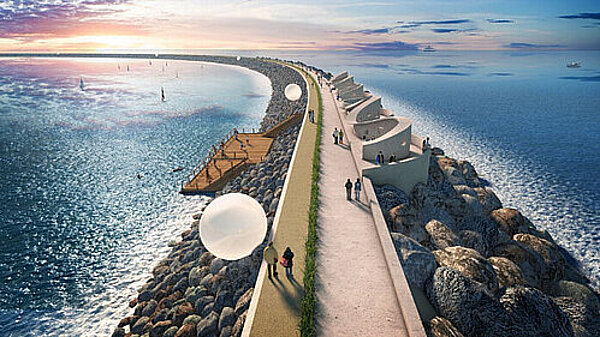
The Swansea Bay Tidal Lagoon is Oven Ready – It's Time Labour Acted
In 2018, the Conservative government pulled the plug on the Swansea Bay Tidal Lagoon. With the stroke of a pen, Conservative ministers cancelled what would have been the world’s first purpose-built tidal lagoon power station; an oven-ready project with planning consent, local backing, and international significance. Seven years later, the verdict is in: that decision was a monumental mistake.
The newly published Severn Estuary Commission report confirms what the Welsh Liberal Democrats have argued all along. Tidal lagoon power in the Severn Estuary is feasible, valuable, and strategically important. Crucially, it concludes that tidal lagoons, not mega-barrages, are the right way to unlock that potential. In other words, the very model Swansea Bay pioneered was the correct one.
Yet instead of leading the world, the UK is still talking. And Swansea is still waiting.
When the Conservatives cancelled the project, they claimed it was “too expensive” and “poor value for money”. What they failed to account for was value in the round: long-term energy security, industrial regeneration, grid stability, and the chance to build a global export industry in Wales. The Severn Commission now makes clear that tidal lagoons offer predictable, low-carbon power with system benefits wind and solar alone cannot provide. Had Swansea Bay been built, it would already be generating clean electricity today, while providing exactly the kind of firm power South Wales now desperately needs.
The lost time is staggering. Swansea Bay was not just a power station; it was a pathfinder. As the Hendry Review recognised, it was designed to prove the technology, build supply chains, and pave the way for future lagoons across Wales, from Cardiff Bay to the North Wales coast. Instead, Britain ceded first-mover advantage. Manufacturing capability identified for Swansea has withered. Expertise has drifted overseas. And a technology Wales could have led is now being explored elsewhere.
The Conservatives must own that failure. Their decision in 2018 did not save money; it squandered opportunity. It denied Swansea thousands of construction jobs, long-term skilled employment, and billions in economic value. At a time when Swansea Bay needed investment and confidence, Westminster slammed the door shut.
But it is not only the Conservatives who must answer questions. Welsh Labour was vocal in opposing the cancellation. They rightly criticised the decision and spoke passionately about the damage it would do to Swansea and to Wales’s green ambitions. Yet now Labour is in government at UK level, they have refused to revive a project that is effectively ready to go. As often with Welsh Labour, warm rhetoric isn’t backed up by concrete action.
That contradiction cannot be ignored. If Labour believed Swansea Bay was the right project in opposition, why is it still off the table in government? The Severn Estuary Commission explicitly calls for a commercially viable tidal lagoon as a demonstration project. Swansea Bay already fits that description. The planning work has been done. The public support is proven. The case is clearer now than it was in 2018.
Meanwhile, South Wales faces a new challenge: powering the industries of the future. Data centres, electrified steelmaking, battery manufacturing, and green hydrogen all demand reliable, low-carbon electricity at scale. Wind and solar are essential, but they are not enough on their own. Tidal lagoons generate power every day, in winter as well as summer, independent of weather systems. That predictability is exactly what energy-hungry industries need if Wales is to compete.
Rebuilding Swansea Bay Lagoon would send a powerful signal: that Wales is open for green investment, serious about energy security, and ready to lead again. It would provide a major economic boost to Swansea and the wider Bay region; creating jobs, anchoring skills, and restoring confidence after years of drift.
The Welsh Liberal Democrats are proud to have championed the Swansea Bay Tidal Lagoon in government and out of it. We believed then, and we believe now, that it represented the best of Welsh ambition: innovative, sustainable, and rooted in local benefit. The Severn Estuary Commission has vindicated that view. The question is whether today’s governments have the courage to act on it.
We will continue to call on the UK Labour government to do what the Conservatives would not: revive the Swansea Bay Tidal Lagoon as an oven-ready project, backed by a modern financing model and national policy support. And we call on the Welsh Government to press relentlessly for its delivery, not just in principle but in practice.
Wales had a chance to lead the world once. We cannot afford to miss it again.